A sharp is not a flat.
Your ear has always known it. Most digital instruments give D♯ and E♭ one and the same key. Music Motion gives the difference back — and lets you hear it.
Two notes with two names — and on the piano, one compromise between them. A4 = 440 Hz.
Music tuned by ear,
not by formulas.
Everything in Music Motion rests on one base: pure Pythagorean tuning — ratios of 2 and 3, that is, pure octaves and pure fifths, without the rounding of equal temperament. The ear is the judge.
It is built for gradual immersion. Tuning, writing, interpretation, accompaniment, orchestration: each can be approached step by step, at the pace of someone learning alone or of someone who teaches.
Your computer keyboard
is the instrument.
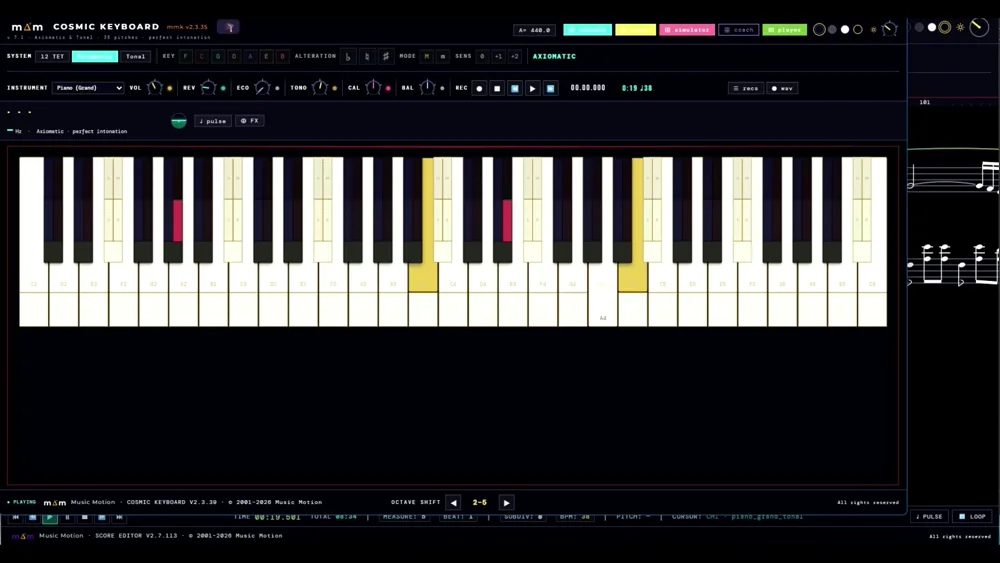
Open the Cosmic Keyboard in your browser and play — QWERTY, AZERTY or QWERTZ, it plays by the position of the key. Each key is split: pure Pythagorean pitch on top, an equal-tempered strip below, so you can compare them side by side. More than sixty instruments, all Pythagorean — the piano included.
Six apps that listen
to each other.
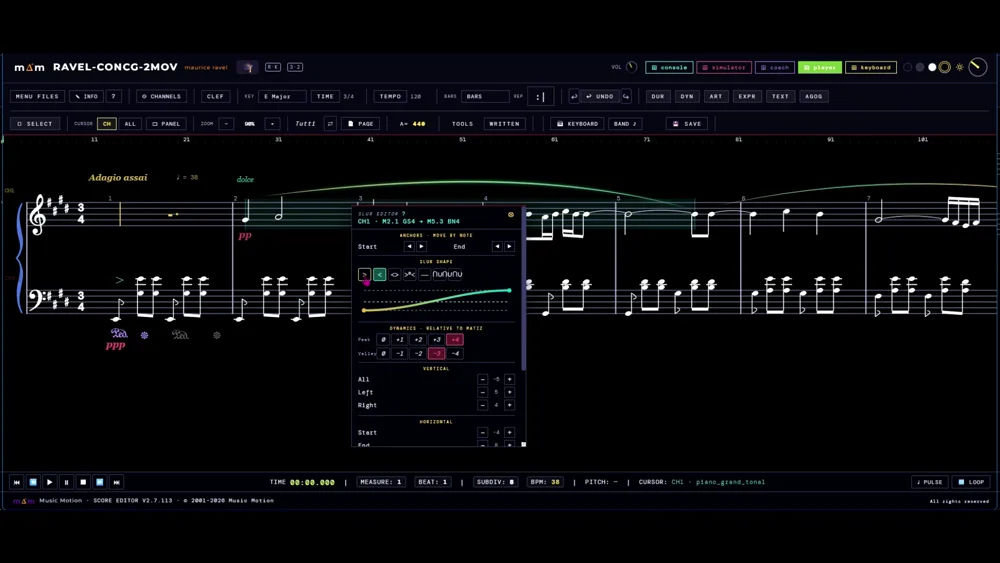
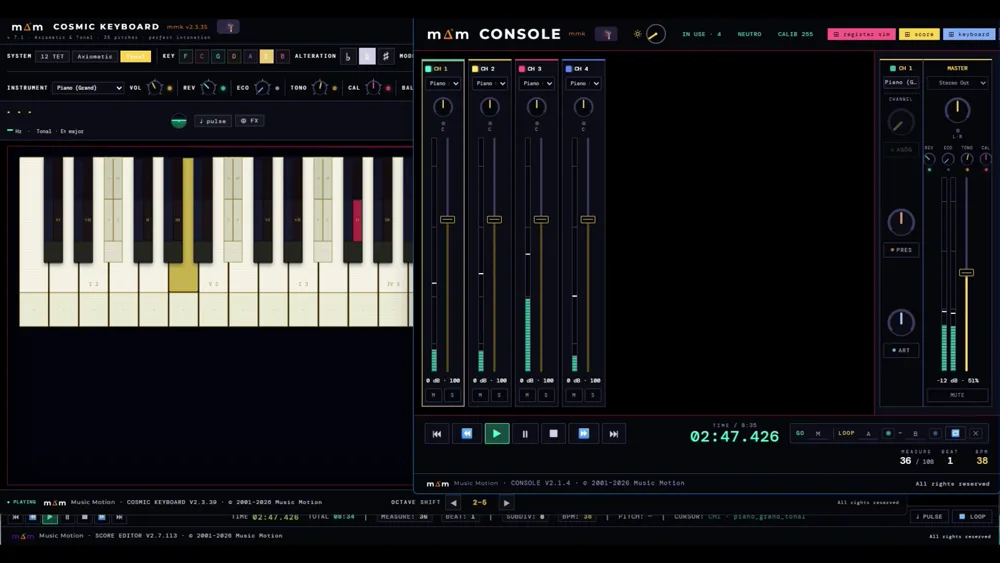
What you play in one, the others receive at once: the keyboard sounds it, the score writes it and the console balances it.
For anyone —
and for the classroom too.
The composition game of the Coach starts from a model melody and ends with a four-voice piece written by you — without having studied theory first.
Study your part with the accompaniment, record yourself over it with the microphone, and keep the take as a WAV to share with your teacher.
Write your own exercises — instrumental practice, harmony, counterpoint, composition — and your students work through them hearing the most natural intonation. Music schools and conservatoires have a programme of their own.
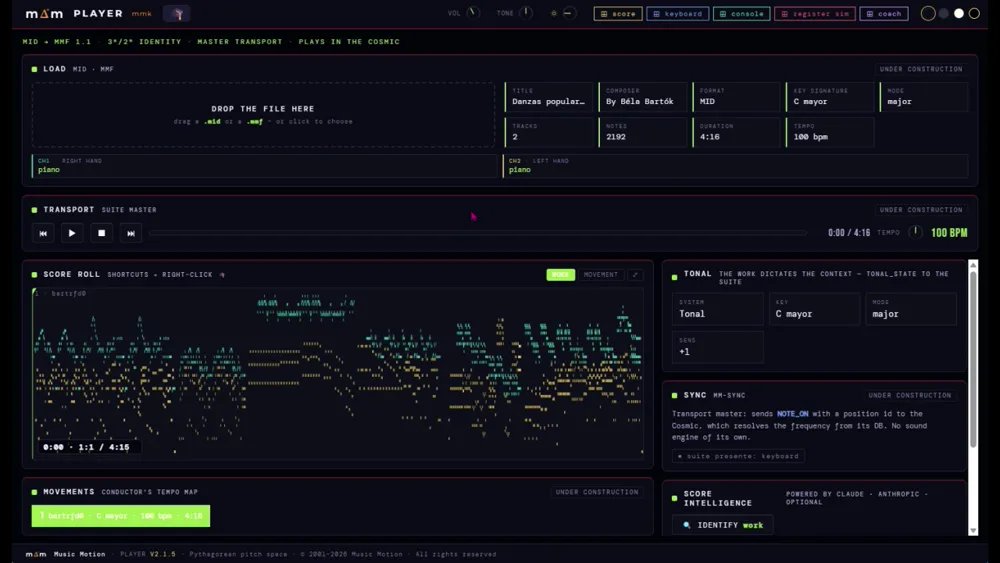
From playing your first piece on the computer keyboard to Chopin’s Prelude no. 4 and Schubert’s Ave Maria — each in the browser, each with a PDF to print.
The site, the user guide, the shortcuts, the instrument library and the exercises.
A tuner that shows the note with its true name, on your computer or your phone. Nothing is recorded or sent.
Hear the difference
for yourself.
Open it in your browser and play. No installation, no equipment beyond the computer you already have.
musicmotionsuite.com